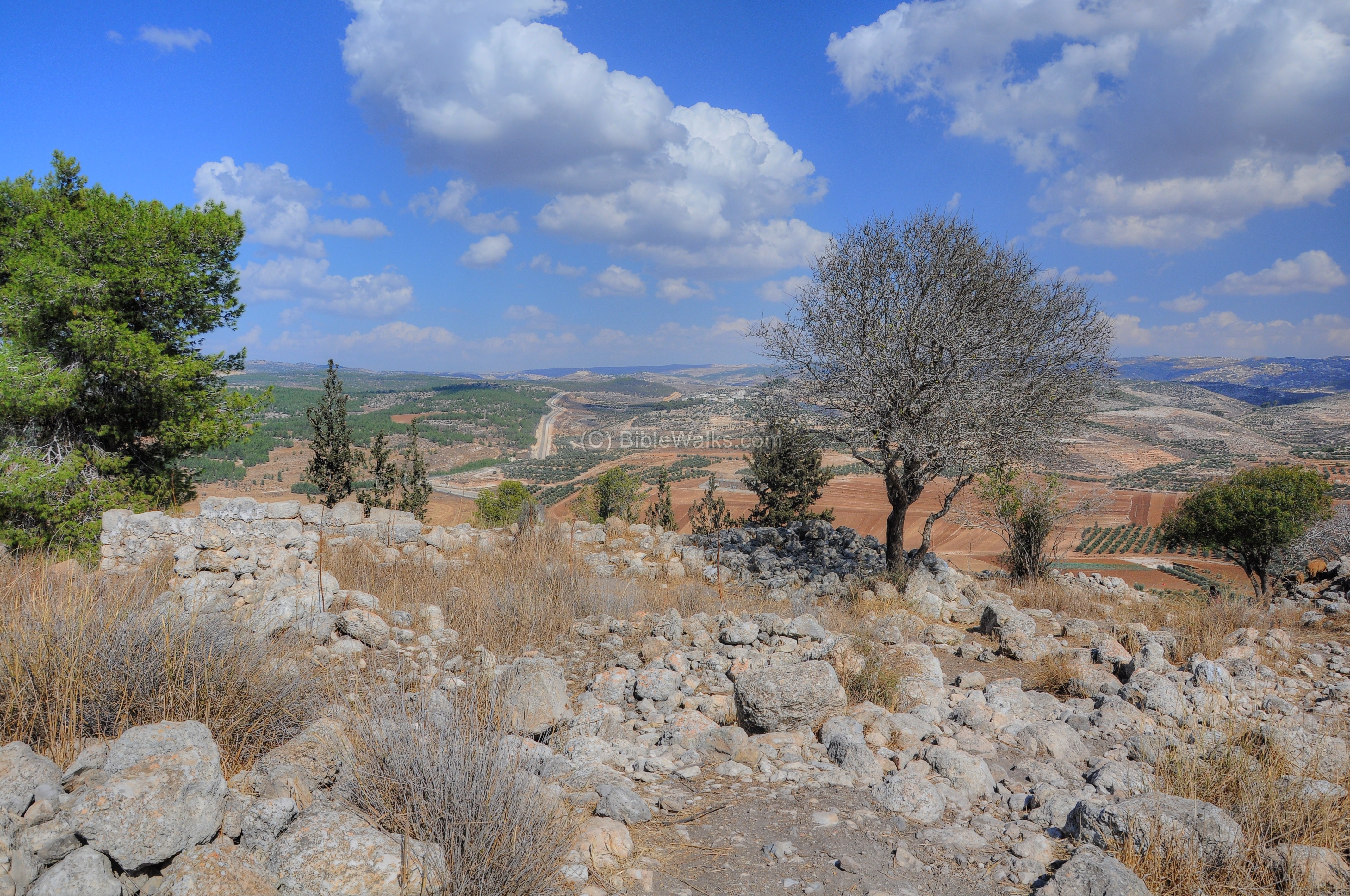
Photo Courtesy of biblewalks.com
The events that occurred in this passage have been attributed to the time when David had just become king over Israel (see 2 Samuel 5). When the Israelites fiercest enemy at that time, the Philistines, heard of David's coronation as king in the town of Hebron, they went up "in full force" to find (and presumably destroy) him, and they camped in the Valley of Rephaim. David was notified of his enemies' intent, and he removed himself beyond the encampment of the Philistines to the stronghold mount of Adullam where amongst the caves he would spend time with the Lord and inquire as to his military movements against the Philistines. David was very intentional at petitioning the Lord as to whether he should move against his enemy and the method in which he should do so. God first gave Him the blessing to attack, which David did at Baal Perazim (place which means "the lord who breaks out") and had such victory that in a hasty retreat the Philistines left their idols behind. And then a second time, David inquired of the Lord, who told the king not to make a direct assault against the Philistines, but rather they were to circle around their enemy and attack from the rear. God instructed David to wait for the sound of marching troops marching in the tops of the balsam trees as evidence that the Lord had gone before His people to strike down the Philistine army. David was obedient to the Lord's command, and God gave him such victory that he drove the enemy north and westward over 15 miles to Gibeon and Gezer. It was a huge military victory for the Israelites.
Even so, there was a period of time that David had to wait before God summoned the king to advance on the Philistines. As David awaited word from the Lord, he looked across the valley eastward from Adullam toward his homeland of Bethlehem, and he yearned for a drink of water from the well near the gate of Bethlehem. As one looks at the picture above, one can imagine David looking back toward the land where he was born and reared, longing to be there but knowing that the enemy was impeding this passionate desire. And anyone from the Israelite camp so daring to wander through the Valley of Rephaim (where the Philistines were) to Bethlehem (where a Philistine garrison was) would be doing so at almost certain risk of death. Still, three of David's mighty men heard their king and made the decision to risk their lives and break through the enemy lines in order to secure the very water of David's hometown.
When the three returned from their emboldened pursuit for the king, David refused to drink the water. He knew what great sacrifice these three made to cross enemy lines to secure what he longed to have. And instead of quickly consuming the gift to gratify himself, David instead offered the drink as a libation to the LORD. David would not treat such sacrifice with contempt, just to satisfy his own desires; he revered too much the valor and courage of the men who gave it to him. And for this reason, he gave it to the Lord.
This is a good word for us, for we see in the king a reverence for acts of love demonstrated toward him. Rather than trivializing the gift, David offered it to the Lord, who was worthy of such a gift. When we ourselves receive gifts of love and sacrifice from others, how do we respond? When we see circumstances in our lives act like formidable enemies, impeding the longings of our hearts, only then to find a friend coming to our rescue to bridge us to blessings, do we celebrate their selfless acts of kindness and devotion? And on the other hand, are we willing to place our own lives on the line to help others who are struggling with painful ordeals and yearn for the waters of blessing in their lives?
Most importantly, do we see the desires of our King, Jesus Christ, as expressed in His Holy Word, and do we desire to fulfill His longing for us by sacrificing ourselves to bring Him glory? Are we willing to put everything on the line to satisfy the longing of His heart? Much like David pouring out the water as an act of worship to the Lord, so may we see that when we serve the Lord, we are expressing through our sacrifices our worship to Him as an expression of love and thankfulness for all that He already has done and continues to do in and through us.
Most importantly, do we see the desires of our King, Jesus Christ, as expressed in His Holy Word, and do we desire to fulfill His longing for us by sacrificing ourselves to bring Him glory? Are we willing to put everything on the line to satisfy the longing of His heart? Much like David pouring out the water as an act of worship to the Lord, so may we see that when we serve the Lord, we are expressing through our sacrifices our worship to Him as an expression of love and thankfulness for all that He already has done and continues to do in and through us.


No comments:
Post a Comment